
Piano & Modern Lifestyle
Why Learning Piano is now a Good Productive Escape of Digital Overload.
The problem of digital overload is now a characteristic feature of life. There is little room to reflect and be at peace due to constant notifications, screen time, and information flow. Piano education is also viewed as a worthy alternative to this space, where it provides concentration, attention, and active intent. This paper explains the benefits of learning the piano as a way of preventing digital fatigue, how it brings back stability and why increasing numbers of individuals are returning to the piano as a means of reconnecting with themselves.

The use of digital technology has changed the way individuals work, communicate and relax. These changes have made life efficient and convenient; however, they have also led to a culture of being stimulated all the time. The screens take center stage and the time when one can just listen to what is being said is becoming more and more an exception. Most individuals are mentally tired, even when they are motionless.
In reaction, there is an increasing desire in activities that relieve the saturation of digital. Learning piano has become one of the silent means whereby an individual can leave screens successfully without leaving any meaningful activity. Piano practice is not facilitated by passive entertainment as it needs presence, intent, and touch.
Such an increasing change uncovers a greater desire. Individuals are not merely seeking a way to be distracted by the digital life. They are pursuing equilibrium, richness and lucidity. All three are provided through piano learning.
Cognizing Digital Overload
Digital overload happens when the brain receives incessant input without time to digest or be able to relax. Notifications are distractions to thinking. Information is absorbed at a high rate and sometimes without thinking. In the long run, this trend makes people less attentive and mentally more exhausted.
Several individuals find it challenging to concentrate on individual activities including those that they like. The relaxation process is shallow with attention being divided. Such a state complicates the process of being really rested.
It takes more than the restriction of screen time to reduce digital overload. It involves substituting online activities with pursuits that are not only absorbing, but also relaxing. The Piano learning offers this naturally.
Why Piano Learning Makes You Go Digital-Free
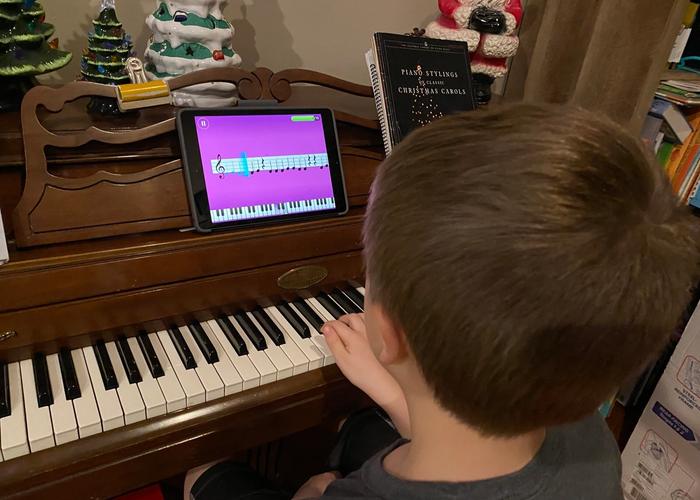
Learning Piano establishes a physical barrier between the learner and the computer machinery. Hands are occupied. The focus is made on sound and movement and not on screens.
Contrary to most other activities that can be performed at the same time with a computer in hand, practicing the piano needs complete attention. You can not multitask and at the same time achieve quality. This need promotes deliberate dissociation.
With time, learners will be used to the practice of piano as an escape of digital noise. The instrument will be an area of undivided attention.
Piano as a Physical Nature of Learning
There are very passive digital experiences. Piano learning is physical. It involves the body actively in terms of movement, posture and coordination.
This physical activity lays down focus. The feel of keys, the heaviness of motion and sound vibration enable the learners to be re-connected with the physical world.
This effect of grounding will prevent the sense of disembodiment that comes with the extensive amounts of screen time. Piano classes restore consciousness in the body.
The Replacement of Scrolling by Focus
The content on the internet promotes unlimited consumption. The learning of piano substitutes the pattern with creative concentration.
Learners do not gulp information but create sound when they want to do so. Every note needs to be selected and taken care of. The focus becomes internal and not external.
This turns the tide back in favor of power. The learners are in charge of the experience other than responding to it.
Why Learning Piano is Mentally Restorative
Even though it takes effort to practice the piano, a significant number of learners explain that it was refreshing to their minds. This contradiction is present since mind clutter is minimized when we are fully present.
By having a single focus of attention, the background thoughts subside. The task at hand is preoccupying the mind.
This absorption brings about the state of a clear mind, which is the extreme of digital fatigue.
Sound as a Process of Attention Restoration
Sound unfolds over time. It cannot be hastened or skipped without repercussions like in the case of the digital media. Learning of piano trains patience where attention is made in line with sound.
Students are active listeners and not passive. This listening makes one more alert and slows down the inner rhythm.
Sound itself serves as a focal point in attention, and it pulls the attention out of a disjointed thinking process.
The reasons Piano Learning would promote the use of intentional time
There are digital platforms that are meant to waste time unconsciously. Learning of piano overturns this relationship.
There are distinct start and stop points of practice. There is a deliberate passage of time instead of time wasted. Students tend to be more conscious in regard to time they use prior to and after practice.
Such consciousness helps in maintaining healthy associations with technology in general.
Piano Learning: How this Helps to decrease the noises of the mind
Mental noise can be described as the stream of thoughts that are always in a competition to be given attention. Piano study eliminates this noise as it involves complete involvement.
With the emphasis which learners put on sound and movement, intrusive thoughts are eliminated. The mind will relax without being compelled.
This quiet is not emptiness. It is clarity.
The reason why practicing the piano is grounded
Being present gives one groundedness. The learning of piano produces this presence by using sensory.
The touch of keys, the note and rhythm of motion keep the focus in the present. This anchoring is in opposition to the virtuality of digital communication.
With time, students become more stable and relaxed.
The impact of Digital Overload on Creativity
There is not time to be creative due to the constant consumption. In the case of constant external focus, one can have hardly time to look inward.
Creative space is reinstated by learning the piano. Students also learn sound, expression and interpretation without being pressured.
When it is shielded, creativity comes out automatically.
The rationale behind why Piano Learning helps with Emotional Reset
Emotional tension is usually enhanced by digital overload. Piano learning provides an avenue of resetting without avoiding.
Sound is the ability to express and not explain. The music is capable of moving the feelings without labels.
This emotional release helps to maintain equilibrium and sanity.
Silence and Piano Learning Relationship
There is a lot of silence in online spaces. Silence is re-introduced in piano learning.
Pauses between notes matter. Silence is constituent of expression as opposed to absence.
This acquaintance with silence teaches solitude, a scarcely more common thing.
The Piano Learning Alters the Everyday Digital Habits
Most learners observe that there are changes in their use of technology outside of practice. They are more discriminating and deliberate.
Focus does not seem expendable. The time wastage in scrolling is not as fulfilling as concentrated interaction.
Habits are reformed without rigid rules in the process of learning piano.
The Reason why Piano Learning Promotes Reflection
Reflection needs continuous time. There is an inherent aspect of piano learning that generates times of pre-practice, in-practice and post-practice reflection.
Students take into account improvement, difficulties, and emotional reaction. This introspection enhances the self-perception.
Online spaces do not facilitate this kind of deeper reflection.
The Mental Relief of Producing as opposed to Consuming
Creation restores balance. Learning of piano positions the learner in a creative, and not a consuming position.
Sound is made by means of hard work and decision. This agency is opposed to passive digital habits.
Creation is a meaningful activity since it involves involvement.
The reasons Piano Learning is conducive to Sustainable Balance
In contrast to the digital detox trends which are based on restriction, the piano learning provides replacement.
Instead of getting rid of technology that has no purpose, it proposes an activity that will inherently decrease the use of screens.
Such sustainability increases the permanency of the change.
The strengthening of attention boundaries by Piano Learning
There are attention limits defining what is worthy of attention. Learning of the piano strengthens these limits by practicing.
Students can notice that they have lost focus and have to refocus it. This is a talent that has moved outside music.
Tighter boundaries minimize online deluge.
Why This Shift Is Growing Now
Consciousness in digital overload grows. It is only natural that many people understand that it is time to engage more.
Piano is a subject that goes hand in hand with this awareness; as it provides focus, creativity and relaxation in a single activity.
Its development is a measure of the shifting priorities and not temporary trends.
Cultural Value of Skills that are Offline
In-person skills which means being in person are receiving a new respect. This change is evident in the learning of piano.
It puts more premiums on patience, paying attention, and depth than speed and volume.
The values strike quite well in a digitally saturated world.
What Makes Piano a Particularly Good Practice in Relation to other activities?
Numerous activities do not involve much screen time but can be distracting. Piano learning does not.
The tool requires involvement. Sound acts instantly to attention or absence thereof.
This sensitivity makes presence stronger when compared to abstract objectives.
Prolonged Effect of Relapse on Mental Health
As time progresses, learning about piano helps in leading to the development of clarity in thought and emotional stability. Learners feel less mentally tired and have a better concentration.
These advantages accumulate at a slow rate and become constant.
The piano is a permanent prop as opposed to a temporary escape.
The reason Piano Learning is a Control Restorer
Attention is usually regulated through design in digital environments. In learning piano, the learner is given back control.
Sound reacts to purpose and not to algorithms. Advancement is not a result of interactions but hard work.
This control favours trust and independence.
The Future of Learning Piano in a Digital World
Due to the ever-changing technology, grounding of activities will be on the rise. The learning of piano has a classic remedy.
It does not oppose tradition and modern life. The tool is relevant as it targets the basic needs of humans.
This applicability is a guarantee of further development.
Conclusion
The problem of digital overload has caused the general feeling of the need to have depth, focus and balance. Piano study fulfils this requirement by providing a purposeful break out of screens without losing touch of being engaged in work.
Piano learning is use of sound, movement, and presence to regain focus, imagination and clarity of emotions. These advantages do not just stop at music, but they also assist in healthy relationships with technology in everyday life.
In a society that is characterized by continuous overload, piano education provides a response to an uncommon and precious thing: an opportunity to re-relate to attention, deliberate action, and identity.
More from the blog
Keep exploring new ideas
Piano: Psychological Development.
How Piano Learning Improves Memory Over Time
The process of learning, adaptation, and growth of people is mainly driven by memory. Learning Piano has emerged as one of the effective techniques of memory reinforcement via formal repetition, auditory, coordination and recalling over time. This article discusses the process by which practicing piano develops various forms of memory, reasons why these advantages become increasingly more effective, and how the benefits of learning a piano help to retain in the minds of non-musical areas.
Piano & Skill Development
How Piano Practice Builds Consistency and Self-Discipline
Self-discipline and consistency are crucial personal qualities in the contemporary life but are becoming more challenging to master. The learning of piano provides a natural and effective method of developing both in a structured form of learning, in a progressive manner and through long term commitment. This paper will examine how practice in the piano will develop the consistency over the time, why the self-discipline will develop naturally at the instrument and the applicability of these abilities far beyond music in the life.
Piano & Lifelong Learning
The Reason behind the Rise of Piano Learning among Mature Beginners in the world.
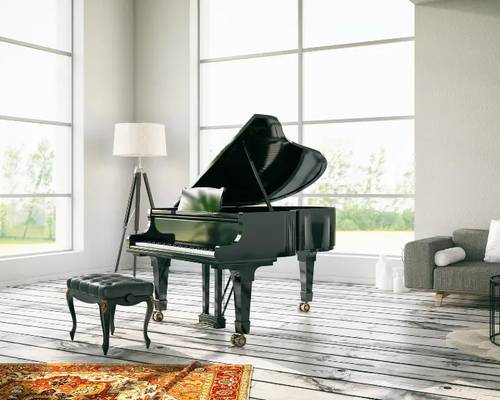
The world has witnessed a potent surge in piano learning among adult learners. More individuals are learning the piano later in their lives and this is due to the flexibility of digital tools, lifestyles and now people are more focused on their personal development. The article discusses the reasons why this trend is being experienced, how adult learners treat piano differently, and why this trend is transforming the contemporary culture of the piano.
Piano & Modern Skills
The reason Learning Piano Is Better than Multitasking in a Distracted World.
Piano learning is becoming an effective tool to reconnect attention and deep thinking in a day and age where we are bombarded with notifications and do not spend enough time in deep contemplation. The mental clarity ensured by years of discipline in the practice of the piano may be that which is afforded by very few activities because it demands constant focus, physical coordination and active listening. This paper discusses the connection between learning the piano and attention, the level of cognitive and mental discipline and the reason why more and more individuals are turning to the piano to overcome distraction in the modern world.
The Culture of Piano and Contemporary Music.
The reason why Minimalist Piano Music is becoming a sound of this decade.
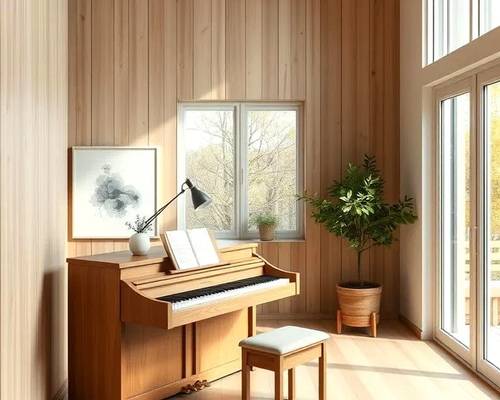
The minimalist piano music has come out as one of the most effective sounds of the modern age. The style is marked by its simplicity, repetition, and restraint, and they are defining the manner in which individuals listen, create, and relate to piano music nowadays. This paper delves into the reasons behind the growth of minimalist piano in popularity all over the world, its reflection of the contemporary life, and why it is a simply a new voice of this decade.
Piano & Future Learning
The Way AR is beginning to transform Piano Learning.
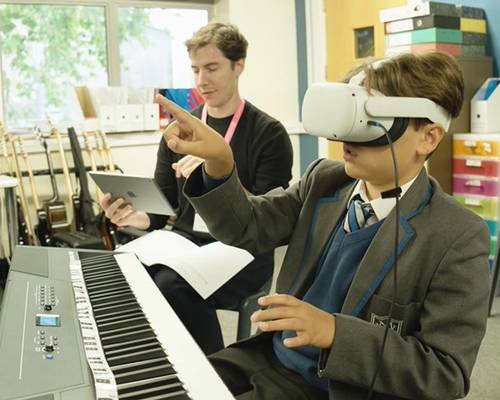
The concept of augmented reality is gradually presenting itself in the business of piano study, providing a fresh interpretation of music, technique, and practice. AR is transforming the interaction between pianists and the keyboard by combining digital guidance and physical instruments to create a new approach to playing the piano. This paper discusses the reasons behind the growing interest in augmented reality learning of piano, its functionality as well as its potential future impact on the teaching of piano.The concept of augmented reality is gradually presenting itself in the business of piano study, providing a fresh interpretation of music, technique, and practice. AR is transforming the interaction between pianists and the keyboard by combining digital guidance and physical instruments to create a new approach to playing the piano. This paper discusses the reasons behind the growing interest in augmented reality learning of piano, its functionality as well as its potential future impact on the teaching of piano.