Notes in Bass and Treble Clef - A Beginner's Guide
July 8, 2026
Notes in Bass and Treble Clef - A Beginner's Guide
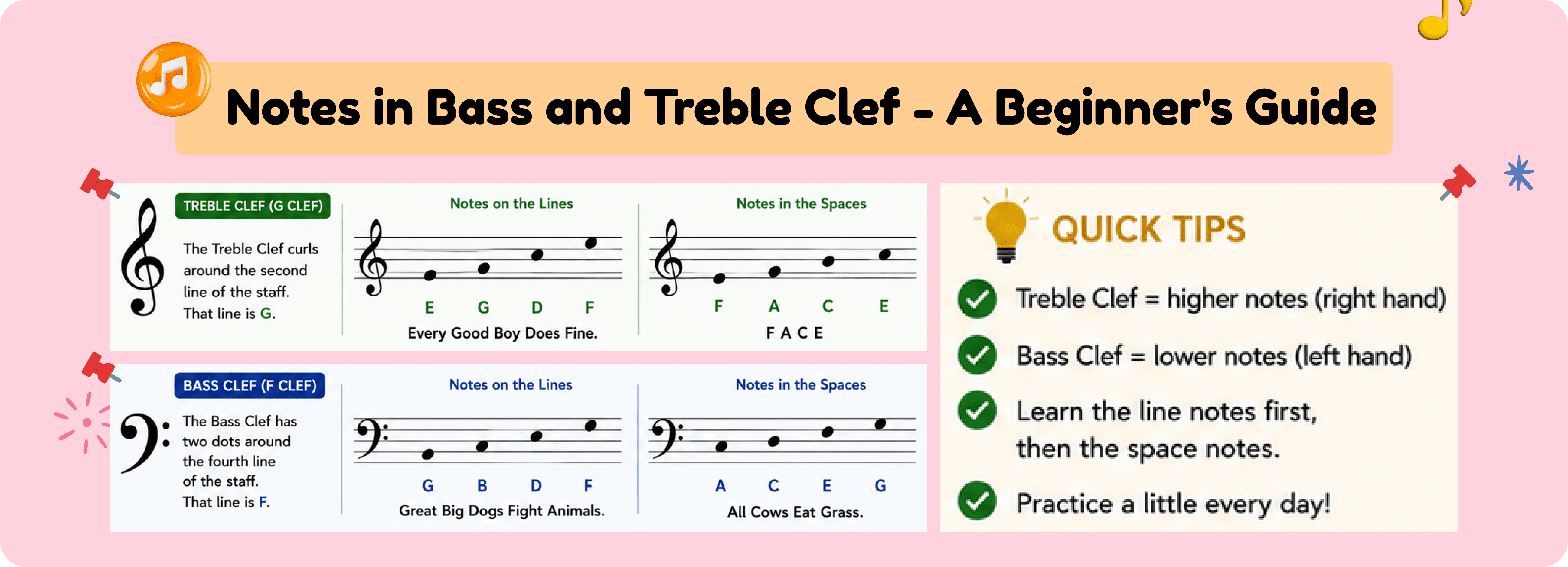
As you start reading more piano music, you will observe that every musical composition utilizes two distinct clefs. It is not done to make the piece look better; it has more to do with the range of notes that can be produced on the piano than anything else. Being one of the instruments with the largest note range, the piano cannot fit all of its notes on one line. For this reason, the composer separates the high and low tones in order to create two clefs – the treble clef and the bass clef.
How the Treble Clef Organizes Higher Notes
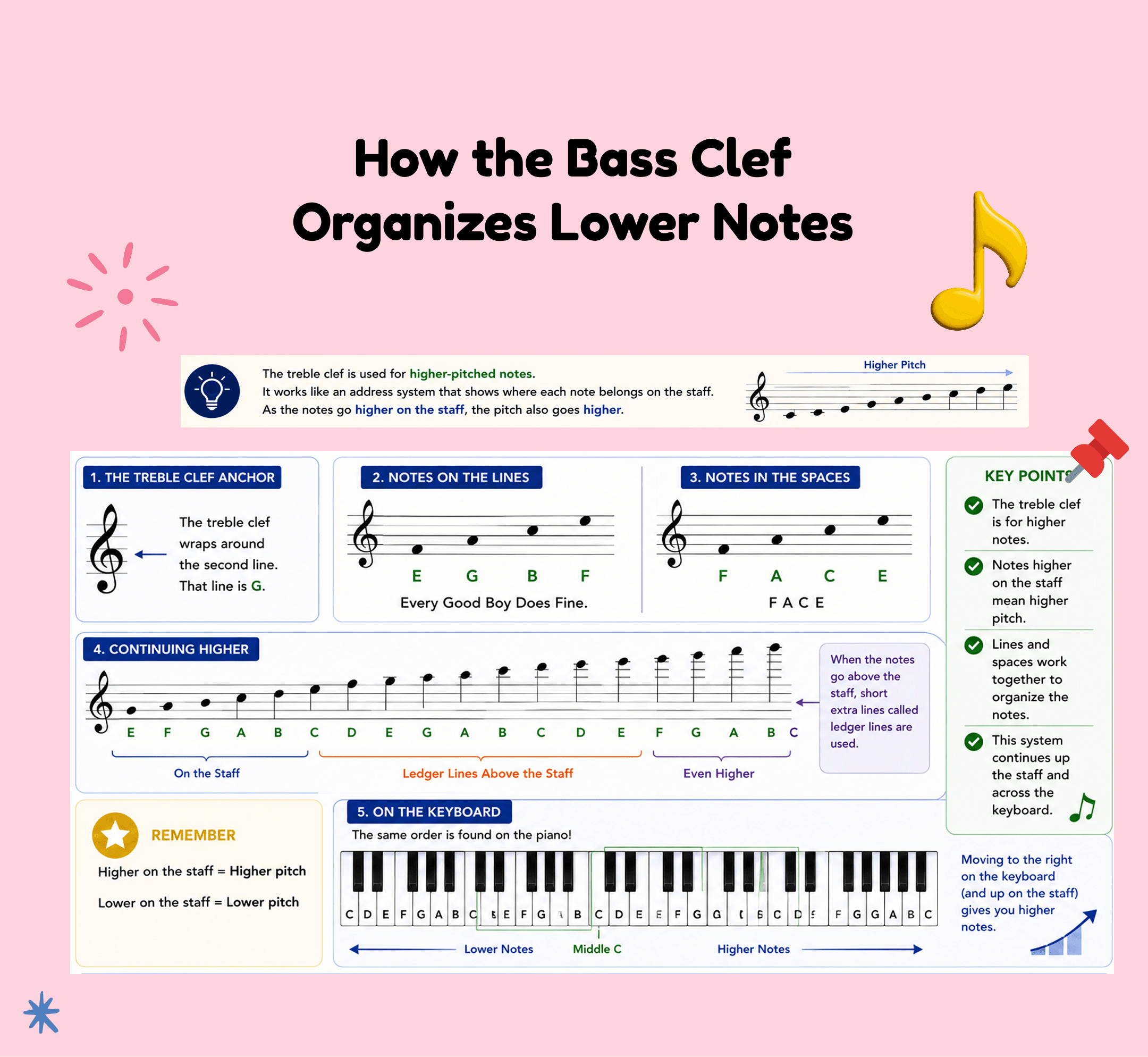
The treble clef is another name of the G clef and is meant to denote higher notes in the piano. The treble clef normally holds the melody, and thus is the first one to learn when beginning. As you start learning how to read notes in the treble and bass clefs, you will realize that the treble clef helps eliminate excess ledger lines so as to make reading of higher notes easy.
How the Bass Clef Organizes Lower Notes
The bass clef, also known as the F clef, denotes the low range of the piano. It is often employed for accompaniment, bass lines, and harmonies that complement the melody played by the right hand. Studying bass and treble clef notes allows you to learn how to use both your hands effectively when playing the piano.
Reading Two Clefs as One Musical System
Though bass and treble clefs have distinct appearances, their purpose is to complement each other and thus create the grand staff to help pianists read any number of notes while not complicating the sheet music. When learning notes in bass and treble clefs, it is important to refrain from thinking of each of these clefs as an independent exercise. It is necessary to see them as one interconnected system for playing with both hands.
Build Confidence One Clef at a Time
Not all musicians are able to learn both clefs quickly; rather, it should be done slowly and steadily. You can start with some exercises using one clef and then move on to some small pieces containing both staves. Such a gradual learning process will make your experience with reading music notes easier and establish your reading skills. After you learn how to recognize musical notes, treble clef, and bass clef, you will be able to work with more difficult sheet music without fear. You can also practice your knowledge of notes on our virtual piano online.
Frequently Asked Questions
Do I need to learn the treble clef before the bass clef?
Beginners learn the treble clef first since the melody is normally written in it and is played using the right hand. Learning the bass clef will become easy once the learner masters reading the treble clef since the process of reading both clefs is similar.
Why does piano music use two clefs instead of one?
Piano music has a wide pitch range compared to other musical instruments. It would be hard for a person to read piano sheet music if it used only one clef since the notes would be overcrowded on a single staff.
How can I remember notes in bass and treble clef more easily?
Try learning just a few reference notes per day instead of memorizing all positions at once. Studying exercises and actually playing them on a piano or digital keyboard will make recognizing notes easier through repeated practice.
Can I play beginner songs using only one clef?
Yes. Lessons for beginners can consist solely of the treble clef or bass clef before both hands are used at once. This helps you get comfortable with the fundamentals before proceeding.
How long does it take to learn both piano clefs?
It depends on the individual, but if you practice regularly on a daily basis, you will make gradual progress. Reading easy musical notes for about 10-15 minutes every day will enable you to easily recognize the notes of the bass and treble clefs.
What should I learn after understanding treble and bass clefs?
The next thing that one should learn once they know about both clefs is the sharps, flats, and naturals. They affect the pitch of the note, which is very important when reading piano sheet music.
Related Lessons
View All Lessons
Ready to Play?
Go ahead and start practicing with our online piano right in your browser. Have fun playing songs, lessons, and more.
Play Now